
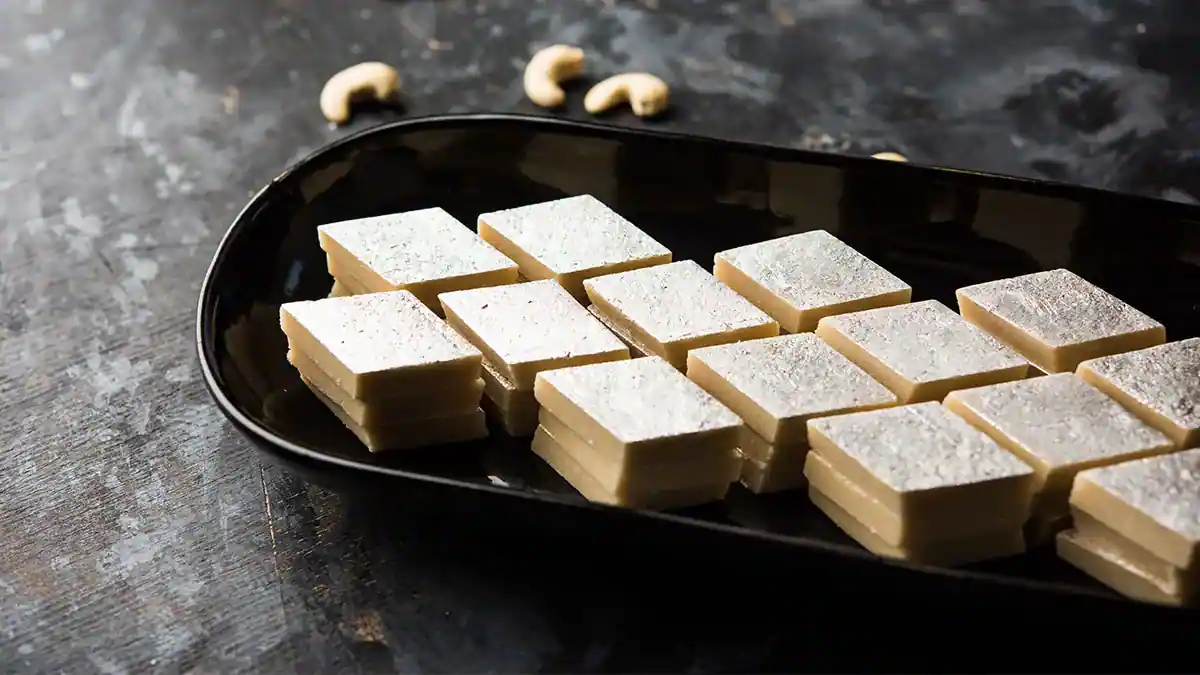
Kaju Katli is known for its thin, diamond-shaped pieces and rich cashew taste. It is made with finely ground cashews and sugar and is often served during festivals or given as a gift. The exact kaju katli origin remains unclear, though.
Some stories trace it to Maratha and Mughal royal kitchens, but no confirmed account exists of where Kaju Katli was first made.
The Story Behind Kaju Katli’s Origin
How Cashews Became Part of Indian Sweets
Cashews are native to Brazil and are commonly said to have been brought to India by the Portuguese in the 16th century. Over time, cashews became part of Indian cooking and were also used in sweets.
Cashews can be ground into a smooth paste or powder and cooked with sugar, which makes them useful in many Indian sweets. The mixture can then be cooked until it forms a soft dough that can be rolled, shaped, or cut.
The Maratha Chef Legend
One popular legend says that Kaju Katli was first made in a Maratha royal kitchen in the 16th century. According to the story, a Maratha chef named Bhimrao was inspired by Halwa-e-Farsi, a sweet made with almonds and sugar.
The legend says that he replaced the almonds with cashews, which had become available in the region. The sweet was then said to have been shaped into thin pieces similar to the Kaju Katli we know today. The name also reflects the sweet itself: kaju means cashew, while katli refers to a thin slice.
However, no firm historical evidence confirms Bhimrao as the inventor, so this story is generally treated as a legend rather than a confirmed historical fact.
The Persian Connection Behind the Recipe
Persian influence is also mentioned in stories about sweets served in Indian royal kitchens. Sweets made with ground nuts and sugar were already part of these wider culinary traditions.
It is unclear when a cashew-and-sugar sweet first took the thin, diamond-shaped sweets form associated with Kaju Katli today. So, while Persian influence may have played a part, no firm evidence shows exactly how it led to Kaju Katli.
From Royal Kitchens to Local Sweet Shops
Kaju Katli is now a familiar sweet during festivals and other family occasions. You will often find it in sweet shops and gift boxes, especially around festive days. The thin diamond-shaped pieces also make it easy to serve and share.
Making Kaju Katli does not require many ingredients. Cook finely ground cashews and sugar together until they form a soft dough. Then roll out the dough and cut it into thin, diamond-shaped pieces.
Today, Kaju Katli is commonly served at festivals and family celebrations and is also a popular gift. Another popular story links Kaju Katli to the Mughal era and the reign of Emperor Jahangir, but this account also lacks firm evidence.
According to the story, Jahangir’s chef made the sweet after Guru Hargobind was released from captivity at Gwalior Fort. However, no confirmed historical record proves this was the origin of Kaju Katli.
How Kaju Katli Became a Festive Favorite
Kaju Katli gradually became a common sight during festivals and special family occasions. Its simple ingredients and smooth texture made it a popular sweet to prepare and share. The thin diamond-shaped pieces also made it a natural choice for sweet boxes and festive gifts.
Some versions include ghee, cardamom, saffron, or rose. Edible silver varak is also commonly added as a decorative finish. Today, you can also find versions flavored with chocolate, saffron, rose, or pistachio. These versions add different flavors while keeping the cashew base and familiar shape.
Conclusion
No one can say for certain where Kaju Katli originated. A few stories about its beginnings connect it to Maratha and Mughal royal kitchens. These stories are still shared today, but no solid historical record confirms any one of them.
Even though its exact origin is still unclear, Kaju Katli has become a regular part of festive celebrations. You can easily spot it by its thin, diamond-shaped pieces and rich cashew taste. It is often served at festivals, and a box of Kaju Katli also makes a familiar sweet to share with family and friends.
